The Coming Great Transition: Healing and the Church

You might have heard the story recently: an Australian man’s dog got terminal cancer. He ran out of options in the normal course of pharmacy. Usually that’s the end it, but this guy was a machine learning researcher and he knew that a combo of new technologies combined with AI might provide a different ending.
Ultimately it did. Within a few months (and a few thousand dollars) he had designed a “one of one” vaccine specifically targeting his dog’s cancer. As it turned out, the hard part was getting permission to give it to his dog from the government (take note of that for later). The good news: he was able to get through the red tape and heal his dog.
The story got out and people were blown away. Then Patrick Heizer, a research scientist, responded:
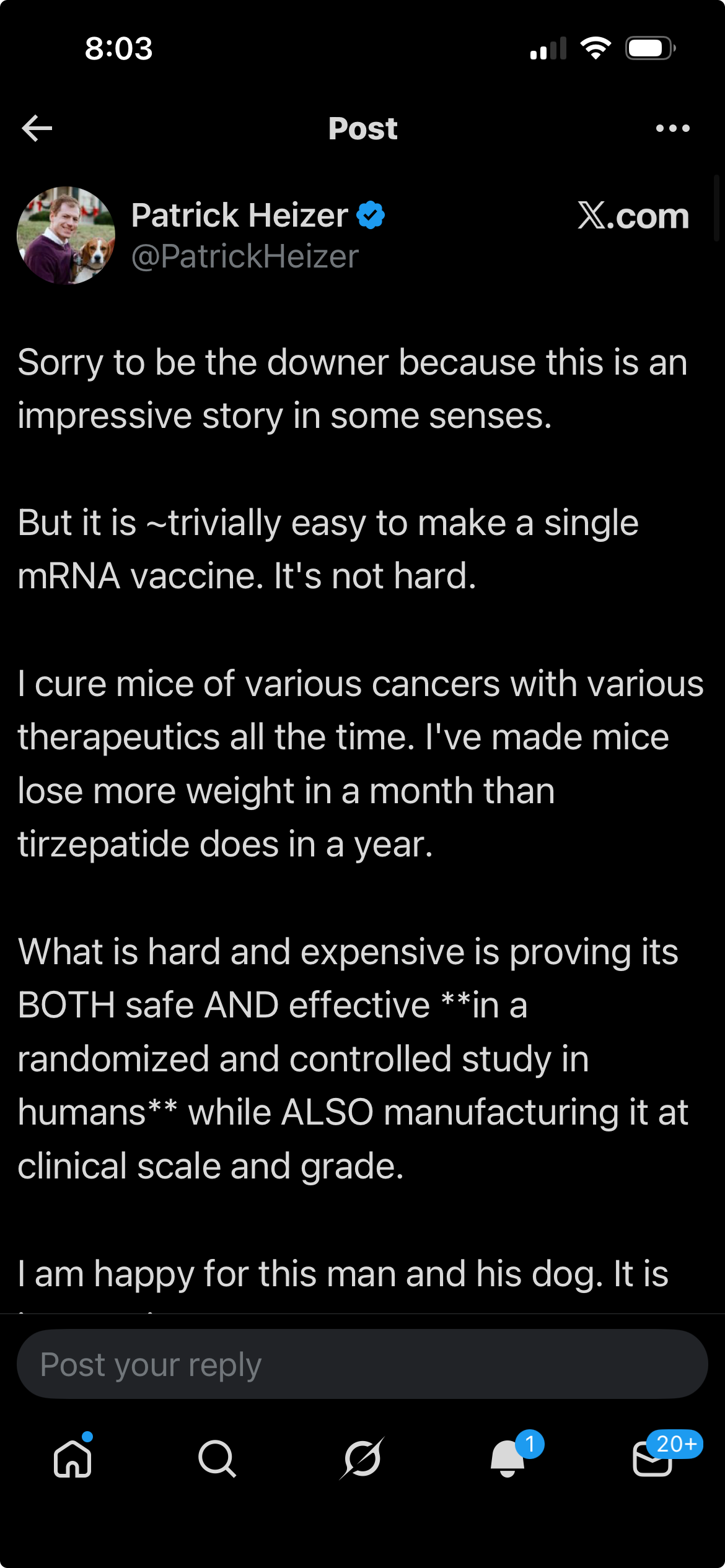
Making a single mRNA therapeutic is “trivially easy.” He does it routinely. He cures mice of various cancers all the time. What is hard — genuinely hard, and expensive — is proving something safe and effective in a randomized controlled trial in humans, while also manufacturing it at clinical scale and grade.
He meant it as a rebuke. Read it again.
Sure, we can cure your terminal cancer - but we can’t prove that if we gave this unique medicine, specifically designed for you, to lots of other random people that it would “safe and effective.” So we aren’t going to give it to you.
Now, I don’t want to push this too far - we are definitely still in the baby-steps stage of this new technology, but what Heizer confirmed is that the molecular work is real, quite powerful and remarkably easy to bring to literally cure cancer. A person with the right equipment and knowledge can design and produce an individualized therapeutic intervention with a real chance of better results than existing treatment, quickly and far more cheaply. There is a lot more science and technology to work on here, but that is not the real blocker.
The bottleneck now is neither scientific, technical or even capital: it’s institutional and perhaps psychological. What remains is a regulatory architecture built for mass-produced standardized drugs, now applied to a world where bespoke molecular medicine is already possible.
-----
The Ground Has Shifted
The 20th Centry model of drug development runs like this: identify a molecular target, design a compound that hits it, run it through a decade of trials across thousands of patients, get FDA approval, manufacture at industrial scale, distribute. The whole system is built for mass production of standardized interventions. It is necessarily slow, necessarily expensive, necessarily blunt. A drug that works in 40% of patients and costs $200k per course is considered a success.
This model is being made obsolete by a convergence of three things: AI-assisted molecular design, rapid synthesis, and precision delivery. Together, they make something possible that was science fiction five years ago — bespoke molecular therapy, designed for an individual’s specific biology, produced in small batches and delivered in weeks. From a high level, the potentially addressable diseases are astounding, including the full spread of oncology, autoimmune disease, metabolic disease, cardiovascular and renal disease, neurodegeneration, rare genetic disease. Taken together, this represents roughly 70% of U.S. healthcare spend — $3.5 to $3.7 trillion per year out of a $5.3 trillion total.
The economics are equally shocking. Today, at the very infancy of the technology, personalized therapy could be provided for single digit thousands of dollars per person. Compare that to the current standard: cancer at $100k–$500k+ per patient, autoimmune at $20–100k per year for life, rare disease at $200k–$2M+ lifetime. Not only could this new approach save lives, it could do so without impoverishing families - or crippling economies.
So, what’s the hold-up?
-----
The Regulatory Wall and the Church-Shaped Opening
The modern pharmaco-medical complex was developed through the 20th Century under the same “mass-industrial” dynamic that drove physical manufacturing and today’s whole system assumes that model. The FDA approval pathway is built around large-scale randomized trials demonstrating population-level efficacy and safety. The industry is designed to invest ten to fifteen years and hundreds of millions to billions of dollars per drug. The institutional assumption baked into the entire regulatory architecture is that you are developing a standardized product to be administered to millions of people. Anything that doesn’t fit that model is illegible and almost invisible to industry and regulator alike.
Individualized, personalized therapy is the exact opposite of this mold. Every patient’s treatment is, essentially, a unique drug. While these treatments might be curing cancer all day long (patient by patient) - they are by definition obscure to “double blind placebo controlled mass” study and therefore can’t be stamped: “safe and effective.”
The result is a regulatory environment in which a company trying to deploy precision bespoke therapy faces essentially prohibitive friction. Every individualized formulation is technically a new investigational drug. You are not just navigating drug approval — you are navigating a system that has no category for what you are doing.
A biotech can try and some might. But they face years or decades of legal and regulatory combat before operating at scale, let alone providing care directly to patients. And because their purpose is ultimately commercial, they will face pressure at every turn to fit into a business model legible to investors and regulators — which means drifting back toward standardized products and away from true bespoke care. The market is going to have a very hard time crossing this chasm.
The state is no better off. Regulators regulate, they do not innovate. And of course the pharmaceutical industry, for its part, has powerful structural incentives against disrupting the existing approval model, which functions as a moat protecting their market positions.
So neither the market nor the state is well positioned to bring this new possibility into fruition. Then who?
My suggestion: the Church.
Let’s begin with the law. The Church occupies a categorically different position under U.S. law than secular companies. Under RFRA — the Religious Freedom Restoration Act — and under constitutional protection of religious exercise, the government faces a very high bar when it wants to substantially burden a sincere religious practice. And healing the sick is as ancient, documented, continuous, and theologically central to the Church as anything. Life, death and the health of the whole person have been the proper responsibility of the Church for two thousand years, long before the Nation State, to say nothing of the FDA even existed.
A Christian healing ministry practicing bespoke molecular therapy as an integrated expression of its theological vocation has a legitimate, well-grounded RFRA claim to operate with substantially reduced regulatory burden. Presuming that the ministry is a sincere religious exercise (as it should be), the FDA’s approval requirements for individualized sacramental medicine constitute a substantial burden on that exercise, and the government would have to demonstrate a compelling interest sufficient to override it, applied in the least restrictive means. Remember the government’s primary interest is *public* heath - a real issue when drugs are being mass introduced to the entire public. But we are looking at something that turns this entirely on its head. The threat to public health is very small - these personalized treatments literally only work for one person. Now, instead of a compelling public interest, the governments restrictions become (undue) restraints on individual liberty and bodily autonomy.
The legal path for a church to deploy this technology and actually care for patients — now, not in fifteen or thirty years — is plausible and *far* cleaner than the path for any secular actor. It’s somewhere between ironic and providential, but the very same institutional morass that will make bringing these cures to people very challenging becomes a window of opportunity for the Church to step back into its historically proper role.
-----
Why Healing Properly Belongs to the Church
Every act of healing presupposes answers to questions that science cannot answer. What is a human being? What is the relationship between suffering and meaning? What is death? These are theological questions, and any healing practice embeds answers to them whether it acknowledges this or not. Modern industrial medicine presumes that the body can be treated independently of meaning — that the patient is a case, the treatment is a procedure, and success is a metric. This is not a neutral technical choice. It is a theological position, and a wrong one.
We need only look back a few years to the COVID era to see clearly what happens when “public health“ operates in a moral vacuum.
The Christian claim is that the human person is an integrated whole — body, mind, soul, spirit — who is part of an integrated community and Church. And that care for the person is an act of stewardship and mercy toward a being made in the image of God. This is the proper frame within which medicine is ordered correctly.
And we must remember that until only the last hundred years or so, it was obvious that the Church held primary responsibility for healthcare. There is a reason why most hospitals carry religious names (does every city have a Methodist hospital?) The Church *founded* the institutional form when the Knights Hospitaller began caring for the sick. Let us not forget that something like 70% of Christ’s miracles were of this nature.
The secularization, industrialization, commercialization and most recently Private Equity pillaging of healthcare over the past hundred years was a departure from that form, *not* the natural state of things.
The Church’s claim on healing is primary. For most of the industrial era, the economics of healthcare forced consolidation into large secular institutions — massive capital requirements, complex supply chains, regulatory architectures designed for scale. But now that constraint is dissolving. The new technology is small-batch, local, individual and this production topology fits the Church’s natural institutional form.
It is time for a return.
-----
The Christian Healing Sanctuary
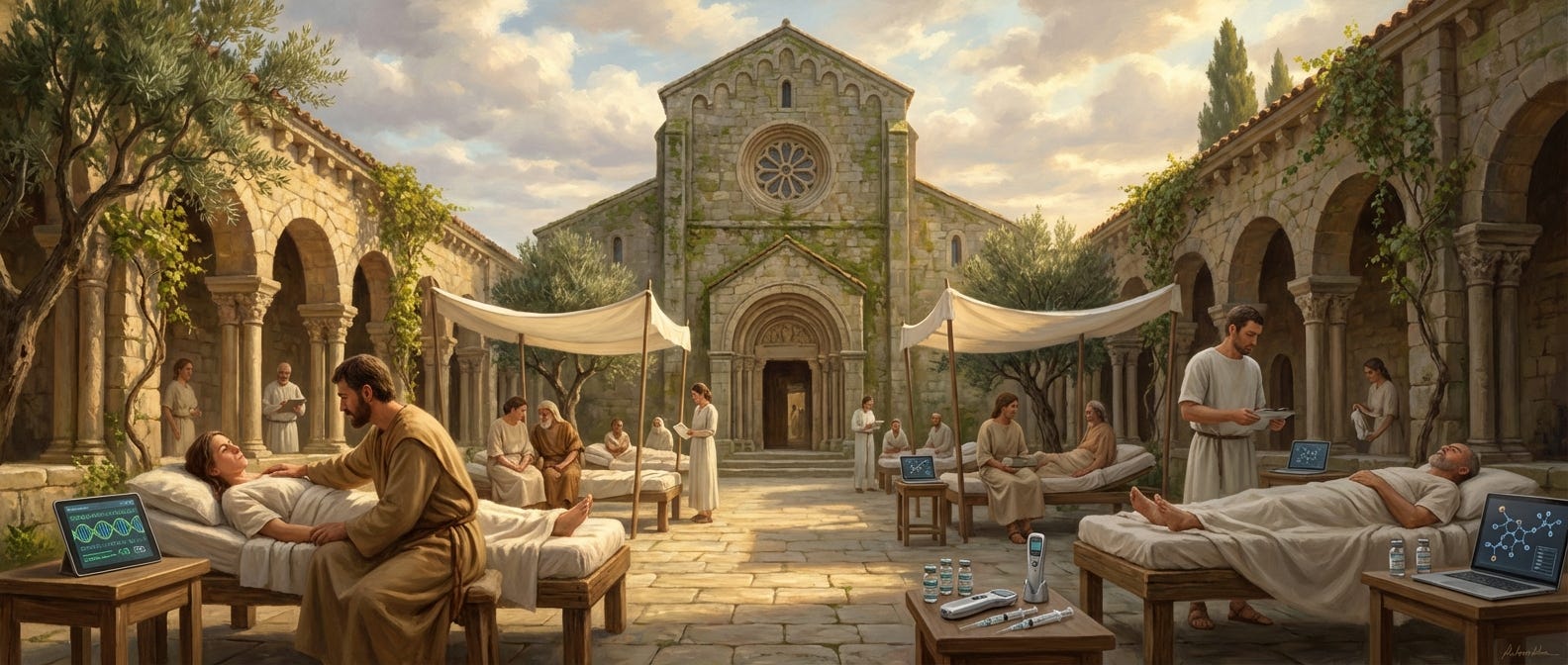
There are many ways to approach this, but my vision of a healing sanctuary has echoes of the monastic and speaks to sacred healing holistically.
Everything matters. Nothing is neutral or indifferent.
The physical environment: quiet, ordered, beautiful, with gardens, clean water, good food, light and proportion. Song and bells audible in the background. Hospitality in its ancient form, recognizing that health is far more than skin deep.
The rhythm: daily life structured around prayer, scripture, silence, shared meals, rest. The person who arrives sick does not enter a system. They enter life.
The process: reception as a person made in the image of God, stabilization, orientation. Preparation through prayer and reflection. Discernment by people called to this vocation — what is fitting for this person, in their specific condition, at this moment? Then intervention: precise, individualized therapy. Then integration: ongoing care, recovery, accompaniment.
The technology is an instrument within a sacred act of healing. It is not the center. It is ordered by the liturgy and held in the devotion of the community.
A person is received as a Person. This is the original form of healing, now equipped with modern tools.
-----
The Disruption and What It Restores
Have that vision? Now let’s go back to the economic disruption.
When a new system achieves a three-orders-of-magnitude cost improvement, better outcomes, and a simpler production topology simultaneously, it replaces the prior system. Regardless of the size or power of the incumbents. The history of technology is unambiguous on this point. The question before us is not whether bespoke molecular therapy displaces industrial healthcare. It is who organizes the transition, when, and in what institutional form.
If the market organizes it, the logic is profit optimization. Bespoke therapy becomes a premium product, stratified by ability to pay, with the full commercial apparatus of marketing, intellectual property, and shareholder return shaping what gets developed and who receives it. Just consider what Facebook or LinkedIn “could have been” compared to what they actually became.
If the state organizes it, the logic is population optimization. Access is determined by bureaucratic priority-setting. The individual patient remains a case in a system driven by a variety of ideological and political motivations entirely disconnected from their wellbeing.
If the Church organizes it, the logic is person-centered healing. The explicit commandment from on high: individual before you is sacred and the ministry exists to restore them. I’m not suggesting that the Church is or will be perfect, but there is simply a world of difference between failing to achieve a high purpose and not having that purpose at all.
And this is the point I want to drive home.
The disruption does something else, something beyond the economics. The past hundred years of industrial healthcare systematically transferred the domain of life, suffering, and death from the Church to secular institutions. These are not peripheral human experiences. They are the moments where meaning is unavoidable. When a person learns they have cancer, they are not having a “clinical experience.” They are having a human experience of finitude and fear and hope. The Church’s original role was to be present at exactly that moment — to receive the suffering person within a frame of meaning that could hold what they were going through.
Beginning with the Black Death seven hundred years ago, industrialized medicine slowly displaced that role by winning an economic and technical argument: it could offer interventions the Church could not, at the scale and cost the modern world required. That advantage is now gone. The new technology and new economics restore the Church’s capacity to be the primary institution of care — and with that capacity comes the restoration of its proper relationship to the most human of human experiences.
That is the vision and while this will of course be hard to deliver - it won’t be really hard. For less money and less time than the Cracker Barrel corporate rebrand, we could initiate the restoration of one of the most foundational aspects of life to Life. This is a civilization bending move and it is only one of several that is emerging in this Great Transition.
110% on board. Agreed that it is a critical pillar of the Divine Economy and a necessary and anointed first foray into an MVP per se.
Thought on parallel/synergistic efforts: @jordanhall - are you aware of the Food is Health effort by Carter Williams, Ellen Brown, and crew?
https://substack.com/@creativedestruction?r=vgnka&utm_medium=ios&utm_source=stories&shareImageVariant=image
Would love to get you all talking/in a dialogos. Feel strongly this would be a powerful alliance…..
Jordan, thank you for such a well-wrought and insightful post; your analysis is truly spot on. I’d love to offer two thoughts that I believe could amplify your message even further.
First, while your focus on the Christian tradition is powerful, I’ve found that the story of health care being rooted in religion is even more universal. From the original Buddhist hospitals of Sri Lanka to the Bimaristan systems of the Islamic Golden Age and the enduring legacy of Jewish institutions like Mount Sinai, every major tradition has a seat at this table. In a time when the lines between church and state are eroding, especially in the US, I believe there’s a beautiful opportunity for leaders like yourself to model a radical inclusivity. This honors how all faiths have contributed to this sacred work.
Second, to your point on the "modern pharmaco-medical complex," I’d suggest we look at the at what I call the "medical triumvirate" by including the insurance industry. Their model often treats care as a loss to be managed through what many call the "Three Ds": delay, deny, and decrease. They frequently hold the final say over both the doctor’s prescription and the patient’s pocketbook, making them a crucial piece of the puzzle you’re solving.
Thanks again for this great post.